WP1
Modelling the thermal influence on material contrasts
The objective of this work package is to investigate, using generic models, the effects of pore-pressure evolution and cooling front resulting from cold-water injections. Several important factors will be specifically considered, including temperature-dependent rock properties, lithological layer transitions and the occurrence of pre-existing fractures and faults. Eventually, the factors controlling the induced seismic hazard will be quantified. The overarching objective is to quantify the parameters governing induced seismic hazard caused by cold water injection experiments.
Preliminary work
In the first step, an analytical approach was developed to integrate pore-pressure diffusion models with synthetic Discrete Fracture Network (DFN) for evaluating the seismic hazard. The analytical framework incorporated fracture network geometry into the Maximum Possible Magnitude (Mmax) of injection-induced seismicity. The resulting formulation can be calibrated to any specific site, provided that the fracture network and the hydrogeological conditions of the subsurface system are well-characterized. To account for parameter uncertainties, Monte Carlo simulations can be applied to estimate the distribution and most probable value of Mmax. The methodology was successfully tested at the Basel site, providing Mmax of 3.4, which is in close agreement with the observed Mw 3.2. This framework provides a physics-based tool for seismic hazard assessment in engineered subsurface projects including EGS, geological CO2 and Hydrogen storage.
Current activities
- THM modeling of cold-water injection experiments in the presence of material contrasts
- Evaluating the thermal stress changes caused by temperature-dependent rock properties
- Fault stability analyses due to long-term cold-water injections
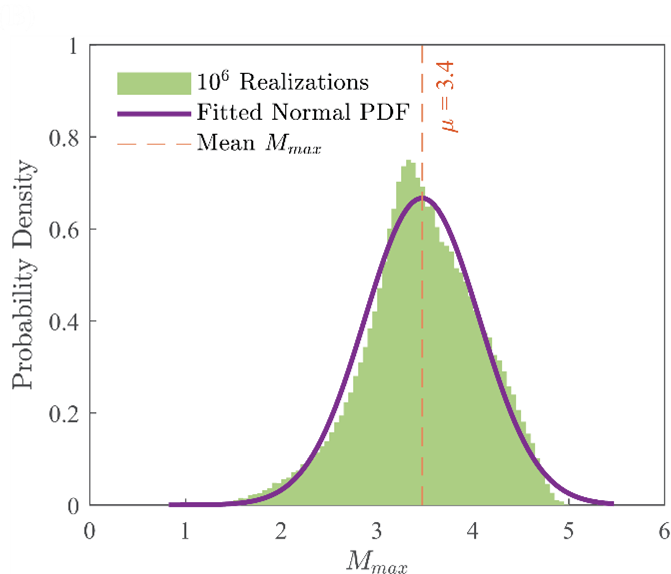
Application of the geometrical Mmax model to the Basel EGS site involved one million Monte Carlo realizations, sampling plausible values of fracture attributes, stress drop and hydraulic diffusivity. The resulting Mmax distribution is well approximated by a normal distribution, with a mean value of 3.4.
WP4
Setup of reference model: Modelling thermal stresses of a generic hydrothermal doublet
For typical geothermal reservoir dimensions a generic 3D thermoporoelastic model will be used to deduce the spatio-temporal distribution of poroelastic and thermoelastic stress changes for testing phase (single well injection, and doublet circulation for a limited time) and for the operational phase (tens of years).
Subpackages
4.1 Doublet model for homogeneous and isotropic reservoir properties
4.2 Inclusion of material anisotropy
4.3 Inclusion of a fault
Current activities
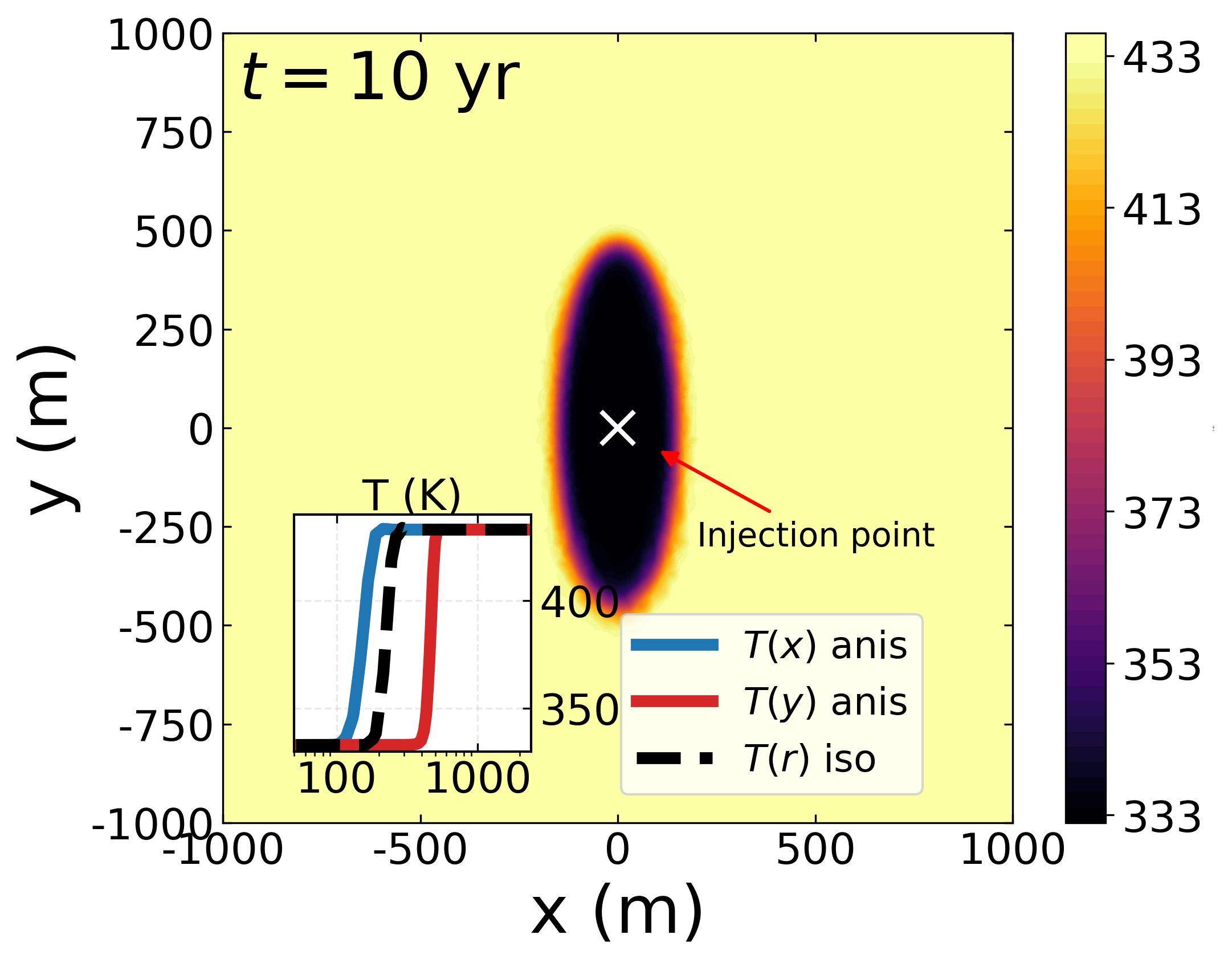
Manuscript for analytical and numerical model of pressure changes in anisotropic medium for a one-well injection has been submitted. Spatio-temporal evolution of THM stress and corresponding Coulomb failure stress changes (ΔCFS) in the homogeneous model is completed. Extension to doublet model within the medium of anisotropic permeability and layered lithology is ongoing.